Data missingness in the forthcoming 2026 IIAG: a preliminary analysis
03 June, 2026
The most comprehensive dataset of African governance
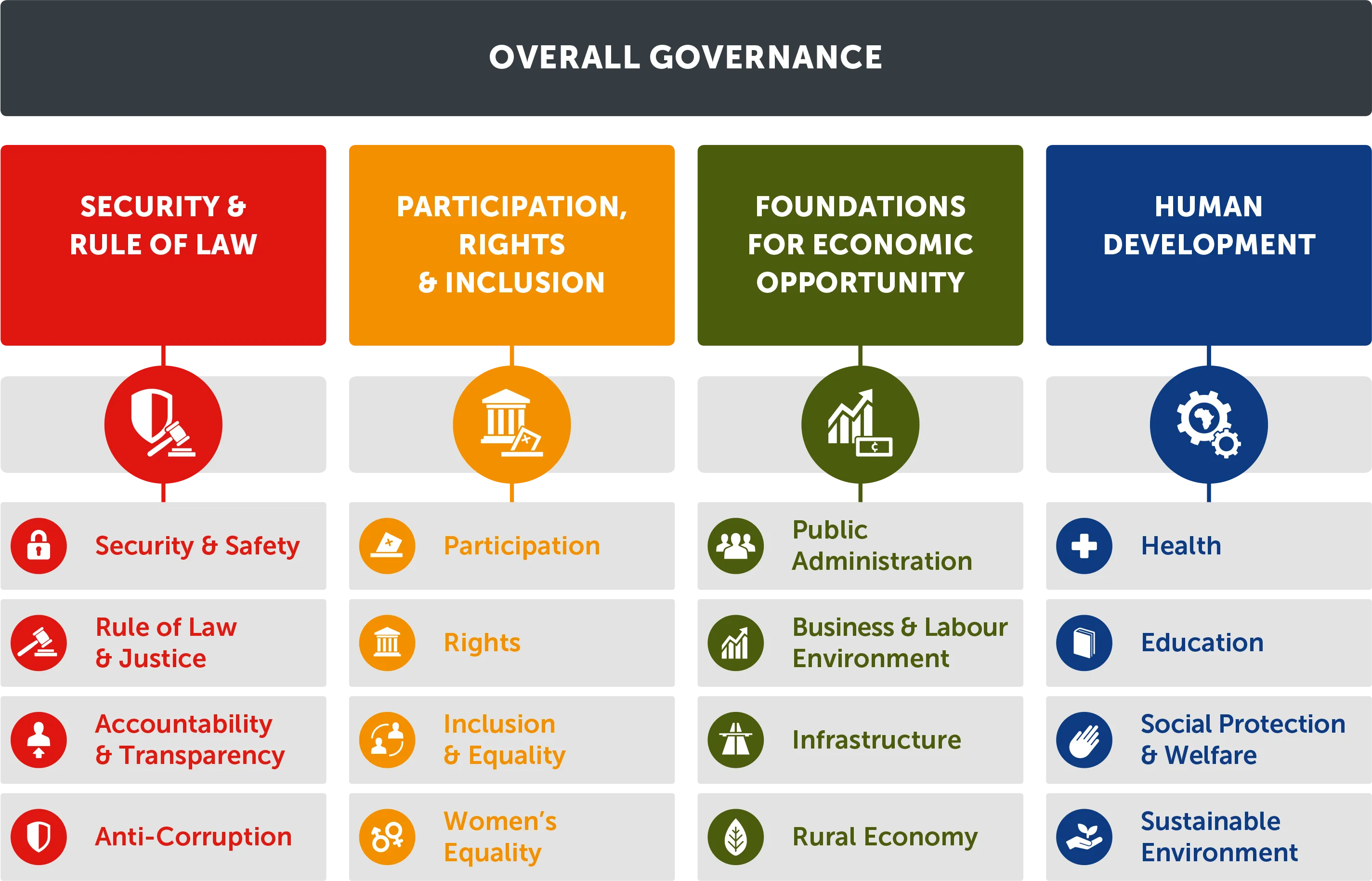
Data collection for the 2026 Ibrahim Index of African Governance (IIAG) is currently underway, with 95% of the Index’s variables already collected from source as of June 2026. The 2026 IIAG framework consists of 319 underlying variables which are collected from 59 datasets, published by 50 sources/institutions. The 319 variables are aggregated into 96 indicators, 16 sub-categories, four categories and one index (Overall Governance) at the top. With extensive country coverage (all 54 African countries over the last decade), the IIAG is the world’s most comprehensive dataset of African governance. The forthcoming 2026 IIAG will cover the decade 2016-2025.
IIAG variable inclusion criteria
To be included in the IIAG, a variable must be linked to the Mo Ibrahim Foundation’s definition of governance and preferably measure outputs and outcomes of governance. Further considerations around the inclusion of a variable include its methodological soundness, timeliness, accessibility, and the credibility of the data provider.
Given these considerations, to be included in the IIAG, a variable:
- must exist at least on a four-point scale
- have at least two years’ worth of data since the beginning of the time series (2016 in the case of the 2026 IIAG)
- the latest data point must exist within the last three years (2023-2025)
- if a variable only has two data points, they must be distinct, and
- these conditions must be met for at least 33 African countries.
Exceptions to these criteria can be made based on the importance and uniqueness of a variable, as well as on the expected availability of data in the future.
Disclaimer
This analysis gives insight into data currently missing from the preliminary 2026 IIAG dataset. It does not cover aspects of governance that are not yet part of the IIAG framework, e.g. a variety of climate action indicators; data on misinformation; or on AI governance, for which no comprehensive datasets yet exist. The existence of data gaps on certain topics or country coverage is what underpins our continued advocacy and material support for data providers around the world.
'Preliminary' indicates that this missingness analysis is based on an incomplete 2026 IIAG dataset. With 95% (303 variables) of underlying data already collected, 16 variables are still outstanding. The remaining uncollected variables are mostly part of the Public Administration (e.g. taxation, budgetary management) and Social Protection & Welfare (e.g. affordable housing, economic inequality) sub-categories. Imputation from raw data/data included according to the IIAG inclusion criteria is done using linear interpolation for data points that are located in the interior of the time series (2016-2025), and using 'last value carried forward' and 'first value carried backwards' for missing data points located in the exterior of the available time series.
High missingness at source for Rural Economy and Education, with 2025 the weakest data year
After applying the IIAG inclusion criteria, missingness at source sits at 32.1% across all 303 variables for 54 countries over ten years (163,620 total possible data points). This is particularly high in the Rural Economy sub-category at 76.2%, because Rural Economy indicators rely solely on one source: IFAD’s Rural Sector Performance Assessment, which currently only provides data for three years: 2018, 2021 and 2024. Similarly, the Education sub-category relies heavily on UNESCO, whose data coverage is especially sparse for education completion indicators (over 85% missingness). This results in an overall missingness of 62.8% for Education.
Missingness at source varies over the years with the lowest being 2021 (21.1%) and the highest being 2025 (58.1%). While it is expected that the latest data year is the 'weakest' in terms of availability due to collection and dissemination cycles, consultations with our data providers have also revealed that current upheavals and funding cuts in the development and data community have negatively affected institutions' ability to conduct fieldwork and publish on time.
Imputation reduces missingness by two thirds
The IIAG’s linear interpolation drastically reduces missingness by two thirds, from 32.1% over the whole dataset to only 11.0%. While Rural Economy and Education still record the highest missingness of all sub-categories, Rural Economy reduces from 76.2% at source to only 19.8% after imputation, a decrease of -56.4 percentage points. Education's missingness is halved from 62.8% to 30.2%. Imputation also evens out missingness over the years and results in a constant 11.0% for each year in the time series (2016-2025).
Missingness is lowest in Participation, Rights & Inclusion, followed by Foundations for Economic Opportunity
Data missing after imputation is particularly low in the Participation, Rights & Inclusion category (5.2%), mainly because indicators in this category rely heavily on data from V-Dem and AFIDEP, two institutions which provide extensive coverage of all African countries. Despite Rural Economy having the second highest missingness and slightly skewing the overall missingness for Foundations for Economic Opportunity, this category is still the second lowest at 11.1%. Human Development records the highest at 14.3%, mainly because of its Education sub-category.
IIAG sub-categories: data missingness after imputation
Benin and Ghana are the only countries with zero percent missingness while conflict countries and small islands lag behind
After imputation, Benin and Ghana are the only countries with no data missingness across all 303 variables and ten years. Their respective pre-imputation missingness of 26.1% and 24.0% suggest that while individual years are missing for them, there is no case in which either country is completely absent from a dataset over the whole time series. Data missingness under 5% is achieved by more than half of the continent (28 countries), with eight of these even achieving less than 1% missingness: Benin, Ghana, Tanzania, Senegal, Madagascar, Kenya, Sierra Leone, and Côte d'Ivoire.
At the other end of the table, ten countries record data missingness of over 25%: Eritrea, Seychelles, Libya, Comoros, Equatorial Guinea, South Sudan, Somalia, Guinea-Bissau, Central African Republic, Djibouti, and Burundi. Most of these countries are either in active conflict, which makes data collection on the ground difficult, or are smaller island states which tend to not be included in many datasets. For example, after applying the IIAG inclusion criteria, none of the above ten countries have data for Afrobarometer’s public opinion indicators due to the difficulty of deploying surveys on the ground, despite Afrobarometer’s impressive expansion of data coverage over the years.
African countries: data missingness after imputation
The relationship between data availability and Overall Governance
Part of a country’s governance performance is a strong public administration, including the provision of reliable, comprehensive data by independent national statistics offices and other agencies. When correlating countries’ Overall Governance scores of the 2024 IIAG with their missingness at source for the 2016-2025 dataset, it shows a negative association between both.

There can be no sound governance without sound data.Mo Ibrahim
In other words, countries with higher Overall Governance scores tend to have lower levels of missingness while countries with lower Overall Governance scores tend to have less complete data coverage. For example, Ghana, Kenya, Morocco, Senegal, South Africa, and Tunisia are among the top ten countries for Overall Governance and have among the top ten lowest missingness percentages. While not a causal relationship, this suggests that missingness may systematically relate to governance performance.
Disclaimer
While most of the analysis in this blog was done using data missingness after estimation, this correlation analysis uses missingness at source to show the original picture of a country’s performance on data provision. Additionally, six African small island developing states (SIDS) were removed from the sample because SIDS are often absent from global datasets due to their size.
The correlation results should be treated cautiously due to the modest sample size of 48 countries, and because it is a simple bivariate analysis that does not control for other factors that might influence data availability such as GDP, government expenditure, or conflict status. The relationship should therefore not be interpreted as causal, but descriptive.
Selected African countries: Overall Governance score & data missingness at source
Stay tuned for the 2026 IIAG launch this October
As we continue working on finalising the full dataset and analysis for the 2026 IIAG launch event in October of this year, stay tuned for our ongoing 'Data Bites' social media campaign, our forthcoming preliminary analysis of the Anti-Corruption sub-category for the African Anti-Corruption Day on 11 July, and our forthcoming Democracy Series featuring International IDEA, citizen data from Afrobarometer, the results of the MIF Now Generation Network survey, and a preliminary analysis of 2026 IIAG democracy and participation indicators.
Read in your language