Rising insecurity represents a major threat to Africa’s domestic resource mobilisation
11 February, 2026
Security incidents are on the rise in Africa. Numerous long-standing and multifaceted causes make it difficult to isolate one single driver. However, increased resource competition emerges as a specific and key driver of conflict. Simultaneously, these conflicts have become a major impediment in leveraging Africa’s domestic resources for sustainable, equitable development.
Driving investment into the continent as well as empowering governments to improve their own capacity to use their own resources relies on peace and stability. Africa continues to pay a risk premium for its global perception as a risky destination for business and development. Addressing rising insecurity must remain at the top of the agenda for Africa if it is to effectively leverage its huge material and demographic resources.
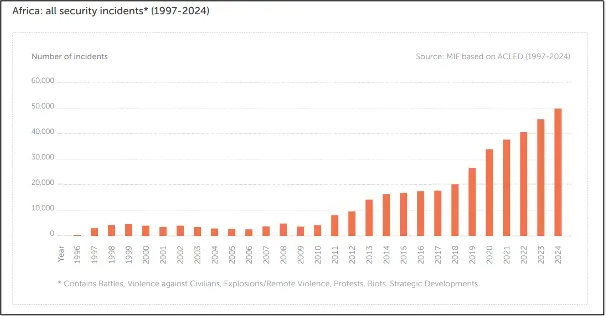
According to ACLED, the frequency of security incidents in Africa has increased significantly from 1997 to 2024, including both violent and non-violent incidents. The total number of security incidents in Africa increased by 87% between 2019 and 2024. Spikes first appeared in 2012-2018 and then again between 2019-2024, with notable spikes in security incident frequency. Even accounting for likely improvements in ACLED data coverage, more security incidents have occurred in the continent in the last five years than in the first 14 years.
Conflict in Africa carries an enormous cost, not only in human suffering but also in economic terms. Wars, insurgencies, and political instability disrupt trade, destroy infrastructure, and displace millions of people, leading to reduced productivity and long-term poverty traps that fuel the vicious cycle between lack of opportunity and conflict. Estimates suggest that African countries collectively lose billions of dollars each year due to conflict, diverting scarce resources away from development and into security expenditure. This has created a vicious cycle where instability stifles growth, and lack of growth further fuels unrest.
Africa is not unique – insecurity is on the rise worldwide
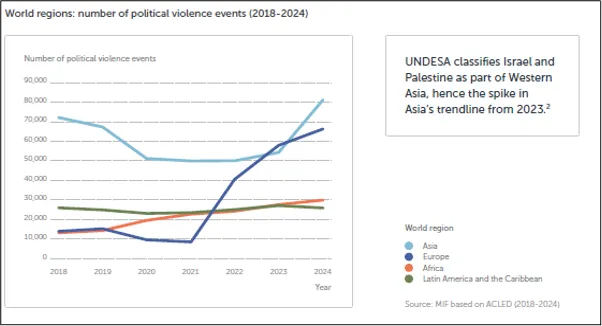
Insecurity is on the rise across the world, not just in Africa, and the dynamics are changing. Whereas in previous decades continents faced waves of instability and isolated hotspots of insecurity, in 2025 many continents face simultaneous conflict across several countries. As a result of the collapsing liberal order, the decline of the US as a hegemon and the crises within the current historical multilateral system, disorderly competition and the rise of new middle powers are opening up space for chaos and conflict. Most world regions have seen an increase in the number of violent events recorded in their countries between 2018 and 2024.
- Europe registered the largest spike in violent incidents during this period, primarily attributable to the Russia-Ukraine conflict which began in early 2022.
- Asia begins the period with a marked decline in incidents but as of 2023 enters an upward trend, mainly driven by the ongoing Israel-Gaza conflict.
- Violence levels remain largely stable in Latin America and the Caribbean throughout the period.
- Africa conforms to the trend of rising insecurity, reporting more violent incidents in 2024 than in 2018. In fact, the total number of reported politically violent incidents more than doubled in Africa, going from 13,233 to 29,760 in 2024.
- Although security conditions have deteriorated in Africa, they are not doing so at a more alarming rate than in other world regions. Although concerning, the uptick in Africa is much less severe than in Europe, or in Asia since 2023